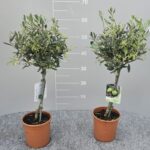
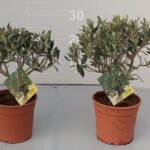
The olive tree is an evergreen arboreal plant belonging to the Oleaceae family, native to the regions of the Mediterranean basin and Western Asia. It can reach a height of 5 to 10 meters, but under favorable conditions and with controlled pruning, it can be maintained in a more compact form. The trunk is initially smooth and gray, but with age becomes gnarled, cracked, and knotted, often hollow at the base, giving rise to specimens of great landscape and historical value. The leaves are opposite and lance-shaped, measuring 3 to 9 cm in length, with an entire margin and a leathery texture. The upper surface is gray-green, while the underside is silvery, covered with a fine hairy layer (tomentose indumentum) that reduces transpiration, making the plant well adapted to arid and sunny climates. The root system is wide-spreading, well developed laterally, and moderately deep. This structure provides excellent drought resistance and good anchorage even in rocky or poor soils. In terms of growth, the olive tree develops slowly, but can live for centuries, becoming one of the longest-living trees known. Many monumental specimens are over 1,000 years old.